

AI Pilot Purgatory
Artificial intelligence has moved from conference speculation to operational reality, but for most organisations it remains trapped in an endless cycle of pilots and proofs of concept that never scale to production value.
The Adoption Reality
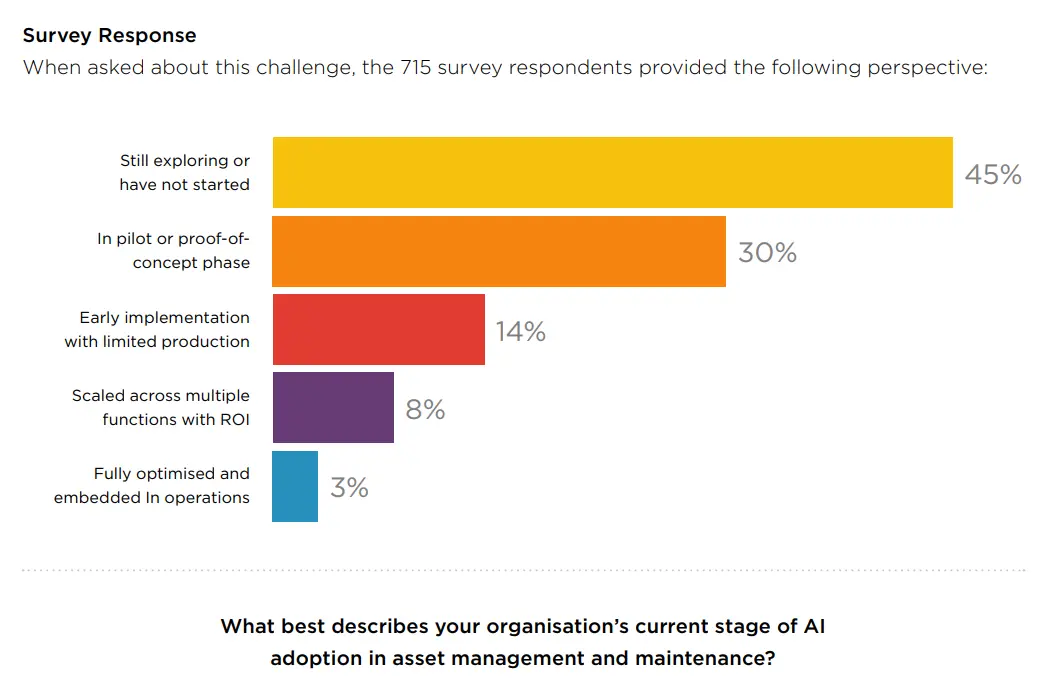
Nearly 45 per cent of organisations are still exploring or have not started with AI. A further 44 per cent are in pilot or early implementation. Only around 11 per cent have reached the point where AI is genuinely scaled or optimised. 72 per cent have explored AI, but 76 per cent fail to achieve expected returns. 70–85 per cent of AI projects globally fail; manufacturing specifically shows a 76.4 per cent failure rate.
The most widely adopted application is not predictive maintenance. It is generative AI, with 52.5 per cent of respondents using tools for knowledge management and everyday productivity. Predictive maintenance ranks second at 37.5 per cent, but roundtable discussion revealed a meaningful gap between evaluating predictive tools and having them running in production.
Many organisations have invested significantly in vendor pilots only to find that integrating the system into operational workflows, addressing the change management challenges, and maintaining the data governance required for accuracy proves far more difficult than the initial proof of concept suggested.
The Skills and Readiness Gap
Data quality is the most frequently cited barrier, followed by workforce AI skills scored lowest of any readiness dimension at 2.69 out of 5. Leadership ambition (3.34) outpaces workforce readiness (2.69).
72 per cent of engineers report that their AI learning is self‑directed, with organisations providing minimal formal training, yet 73 per cent recognise that AI‑related skills will be essential within five years.
“We’re still struggling to see value. Or significant value, because we seem to have a challenge in scaling AI across an asset management domain. We get stuck in pilot purgatory – endless proofs of concept that work in isolation but never make it to production.”
— Maintenance and Reliability Manager, Mining
The gap between leadership ambition and workforce readiness represents the core challenge: intent at the top is outpacing capability on the ground. Organisations investing in AI without first investing in the foundational capabilities – clean data, system integration, workforce literacy, and clear governance frameworks – are virtually guaranteed to underperform.
The pilot typically works because it operates in a controlled environment with dedicated resources and concentrated attention. The moment it attempts to scale across operational systems with distributed responsibility, these advantages evaporate.
What Practitioners Are Worried About
The highest‑rated concern, by a clear margin, was the risk of younger engineers over‑relying on AI outputs. 85 per cent of respondents expressed at least some concern, with 31 per cent rating it as very concerning. This reflects a profession where experience, judgement, and physical intuition are central to safe and effective operations.
“AI doesn’t know when it doesn’t know – and that’s what makes it dangerous. It can’t signal uncertainty the way a human apprentice might. Without expert review, hallucinations get mistaken for insight.”
— Maintenance and Reliability Expert
Accountability and transparency concerns followed closely. More than three‑quarters of respondents worried about the inability to explain or audit AI decisions, and 81 per cent expressed concern about unclear accountability when AI recommendations lead to harm. These are governance questions that most organisations have not yet answered.
The real opportunity, articulated clearly in the MAINSTREAM masterclass series, lies not in optimising an existing process (which delivers perhaps 10 per cent improvement) but in reinventing the process entirely to be dynamic, responsive, and tied to actual operating conditions.
This requires organisations to first answer fundamental questions about how their maintenance processes should work if resources were unlimited and information perfect, then work backward to understand where AI and automation can help bridge the gap. Most organisations instead start by asking where existing processes have bottlenecks and try to smooth them with technology. The difference in outcome is profound.
The State of Asset Management in Australia & New Zealand. This report was developed by the MAINSTREAM research team based on extensive engagement with the asset management community across Australia and New Zealand. We thank the many professionals who contributed their insights and experiences to this research.