

Asset Data Management: Transforming Data Overload into Strategic Value
One of the most significant challenges facing maintenance and reliability leaders today is effectively managing and extracting value from the overwhelming volumes of data generated by ERP and APM systems, condition monitoring technologies, sensors, manual processes, drones, and other advanced equipment. While organisations have unprecedented capabilities to collect data, most struggle to transform this information into actionable insights that drive meaningful business decisions.
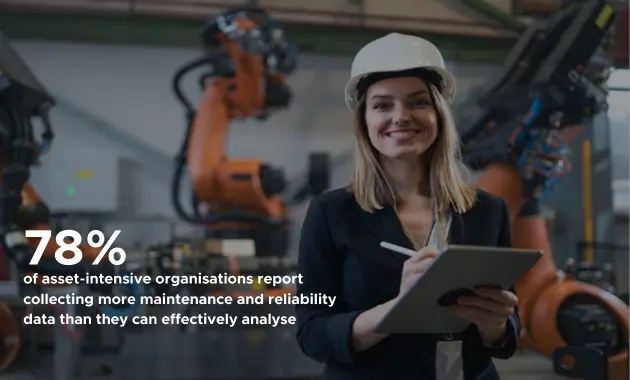
According to a 2024 study by the Australian Industrial Transformation Institute, 78% of asset-intensive organisations report collecting more maintenance and reliability data than they can effectively analyse, with only 23% indicating they systematically convert this data into actionable business insights.
The MAINSTREAM 2024 benchmark study found that organisations with mature data management practices achieve 37% higher asset performance, and 29% lower maintenance costs compared to those with ad hoc approaches.
A comprehensive survey by Deakin University’s Centre for Digital Enterprise found that maintenance and reliability professionals spend an average of 14.6 hours per week searching for, validating, or reconciling data across multiple systems, representing approximately 38% of their available work hours.
"The biggest challenge we have is capturing the relevant data at the right time. We often have too much data or not enough to make a meaningful decision.”
Asset Manager, Utilities
Research indicates that while 91% of organisations view data as a strategic asset, only 34% have implemented formal data governance frameworks for maintenance and reliability information. The key challenges include:
Data Quality and Integrity Issues
Poor data quality remains a fundamental barrier to effective analytics and decision-making. According to the Australian Bureau of Statistics’ 2024 Digital Business.
"Data quality isn’t a problem, finding ways to clearly communicate the data is the real challenge."
Maintenance Manager, Infrastructure
Indicators report, maintenance professionals rate the reliability of their asset data at just 5.8 out of 10 on average, with data inconsistency identified as the primary concern.
"The taxonomy has to be really, really good in terms of your naming convention for your parts, because if it’s not, it can create absolute chaos.”
Reliability Manger, Energy
System Fragmentation and Data Silos
Organisations continue to struggle with disparate systems that don’t communicate effectively. The Australian Digital Transformation Agency’s 2024 industrial assessment found that asset-intensive organisations operate an average of 11.3 separate systems containing critical asset information, with only 26% achieving meaningful integration between these platforms.
Analytical Capability and Skills Gap Organisations face significant challenges in developing the specialised capabilities needed to translate maintenance data into business insights. According to Engineers Australia’s 2024 Skills Forecast, 71% of organisations report critical shortages in data science and analytics skills specific to asset management.
Contextual Intelligence Deficiencies
A fundamental limitation in many data management approaches is the lack of contextual intelligence - the ability to understand data within its operational environment. Raw asset data without context has limited value for decision-making, yet most data collection systems capture metrics without the surrounding operational conditions, maintenance history, and business constraints that give them meaning.
This contextual deficit significantly reduces the usefulness of historical data for predicting future performance or optimising maintenance strategies. Organisations that have made progress in this area have implemented structured approaches to capture and integrate contextual information alongside traditional asset performance data, enabling more nuanced and accurate compliance risks.
Information Lifecycle Management Challenges
As data volumes grow exponentially, organisations face increasing challenges in managing information throughout its lifecycle. Most lack structured approaches for data retention, archiving, and eventual disposal, leading to bloated systems that compromise performance and create compliance risks.
The absence of effective information lifecycle management creates particular challenges when decommissioning legacy systems or migrating to new platforms. Without clear processes for identifying and preserving critical historical data, organisations risk losing valuable information during these transitions, potentially compromising long-term asset management effectiveness.
Strategic Approaches
Leading organisations are addressing these challenges through multifaceted strategies:
- Implementing robust data governance frameworks with clear ownership, quality standards, and lifecycle management for asset information
- Creating cross-functional data teams that combine maintenance domain expertise with data science capabilities
- Developing comprehensive master data management strategies to ensure consistency across systems and processes
- Implementing targeted data literacy programs for maintenance and reliability professionals
- Creating clear data-to-decision pathways that connect information gathering to specific business outcomes and performance metrics
- Establishing data quality measurement frameworks that track improvements and identify priority areas for enhancement
- Implementing integrated asset intelligence platforms that reduce system fragmentation and provide holistic views of asset performance
These approaches enable organisations to transform their data from an overwhelming burden into a strategic asset that drives performance improvement, cost reduction, and risk mitigation across their asset portfolios.
The State of Asset Management in Australia & New Zealand. This report was developed by the MAINSTREAM research team based on extensive engagement with the asset management community across Australia and New Zealand. We thank the many professionals who contributed their insights and experiences to this research.